
Weighted Counterbalance Butterfly Valve
When precise flow regulation and fail-safe closure are critical, a Counterbalanced Butterfly Valve delivers unmatched reliability. This design, often referred to as a Gravity Counterweight Butterfly Valve or Dead Weight Butterfly Valve, uses an external weight mechanism to provide consistent torque assistance, ensuring the disc moves to a predetermined safe position—normally closed—when power or actuation pressure is lost. By eliminating reliance on springs that can fatigue over time, the counterweight system offers decades of dependable service in demanding industrial environments such as water treatment, power generation, and chemical processing. Constructed with a one-piece shaft, robust disc, and replaceable seat, this valve handles pressures up to 300 psi and temperatures from -20°F to 450°F depending on material selection. The counterweight arm is field-adjustable, allowing operators to fine-tune closure speed and balance for specific media characteristics including slurries, steam, and corrosive fluids.
The Weighted Counterbalance Butterfly Valve integrates a rugged ductile iron or carbon steel body with an adjustable counterweight assembly engineered to deliver smooth, chatter-free performance. Every unit undergoes factory testing to verify seat leakage rates below API 598 standards and torque symmetry across the full 90-degree stroke. Below is a detailed breakdown of the standard technical parameters and material options available for this product line.
- Nominal diameters: 2″ to 48″ (DN50 to DN1200)
- Pressure ratings: Class 125, 150, and 300
- Face-to-face dimensions per API 609 Category A
- Actuation: gearbox, electric, pneumatic, or bare shaft with counterweight
- Adjustable counterweight arm with multiple weight plates for field tuning
- Seat retrofit capability without removing the valve from the line
- Fire-safe design to API 607 and ISO 10497 on request
| Parameter | Specification |
|---|---|
| Body Material | Ductile Iron ASTM A536, Carbon Steel WCB, Stainless Steel CF8M |
| Disc Material | Ductile Iron Nickel Plated, Stainless Steel 316, Duplex SS |
| Seat | EPDM, NBR, Viton, PTFE, Metal-Reinforced PTFE |
| Shaft | 17-4 PH Stainless Steel, 316 SS |
| Pressure Class | 125 LB / 150 LB / 300 LB |
| Temperature Range | -50°F to 450°F (depending on seat) |
| Leakage Rate | Zero leakage (soft seat), Class IV or V (metal seat) |
| Counterweight Material | Cast Iron, Epoxy Coated |
| Standards | API 609, MSS SP-67, ASME B16.34, AWWA C504 |
Related Products


Hot Products
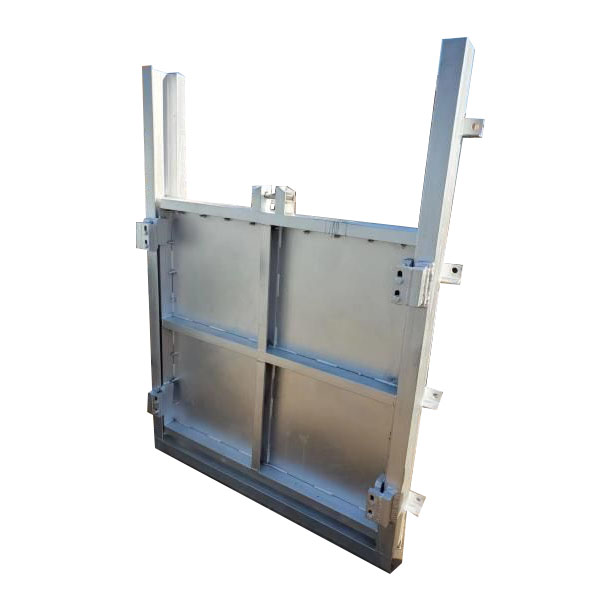
Stainless Steel Penstock Gate Channel Type
FYL is a stainless steel penstock gate channel type manufacturer from China. We have our own factory. After more than ten years of development, we integrate design, production and sales to provide you with high-quality products, comprehensive services and preferential prices. This gate is mainly suitable for water treatment, power stations, hydraulic devices and other scenes. The material and specifications can be customized according to your needs.
Double Girder Gantry Crane
Double girder gantry crane is a special equipment. FYL's factory has been producing and manufacturing this type of equipment and various water conservancy equipment for more than ten years. We have rich experience and a professional team that is very reliable. We accept customized requirements, please feel free to contact us.
Resilient Seat Gate Valve
FYL is factory located in Tianjin China. Factory specialized in producing different type of valves. Resilient seat gate valve is one of major products. Our products has good quality and price advantage, also company available to make OEM products. Welcome inquiries from all over the world.
WCB or Stainless Steel Wedge Gate Valve
WCB or stainless steel wedge gate valve manufactured by FYL factory has a full range of sizes, which can be used in water conservancy or oil. We focus on product quality and will continue to provide you with professional services throughout the sales process, including providing solutions to installation problems.
Bellows Compensator or Expansion Joint
FYL's Bellows Compensator or Expansion Joint is manufactured in China and are designed to provide comprehensive solutions for thermal expansion, vibration, and displacement compensation within industrial piping systems. Utilizing high-grade stainless steel and corrosion-resistant alloys, these components demonstrate superior capabilities in absorbing axial, lateral, and angular displacements, while simultaneously reducing pipeline vibration and noise.
Ductile Iron Wafer butterfly valve with Handle
A high-quality Ductile Iron Wafer Butterfly Valve with Handle, manufactured by the FYL factory in Tianjin, China. This product features a valve body constructed from high-strength, corrosion-resistant ductile iron, combined with a lightweight and compact wafer-style structure. This design not only conserves installation space but also delivers superior sealing performance and precise fluid control. Operated via a manual handle, the valve allows users to easily regulate the flow of various media, including water, oil, and gas.
- Related Blog
- Reviews